
Egypt's Circular Farming & Lessons for Mars Colonization: Closed-Loop Systems in Desert & Space
Egypt is turning vast deserts into thriving circular farms with massive “crop circles,” regenerative practices, & waste to resource systems. Explores the science behind it & why these closed loop techniques are perfect blueprints for sustainable Mars colonization. Engineering bridging Earth & space

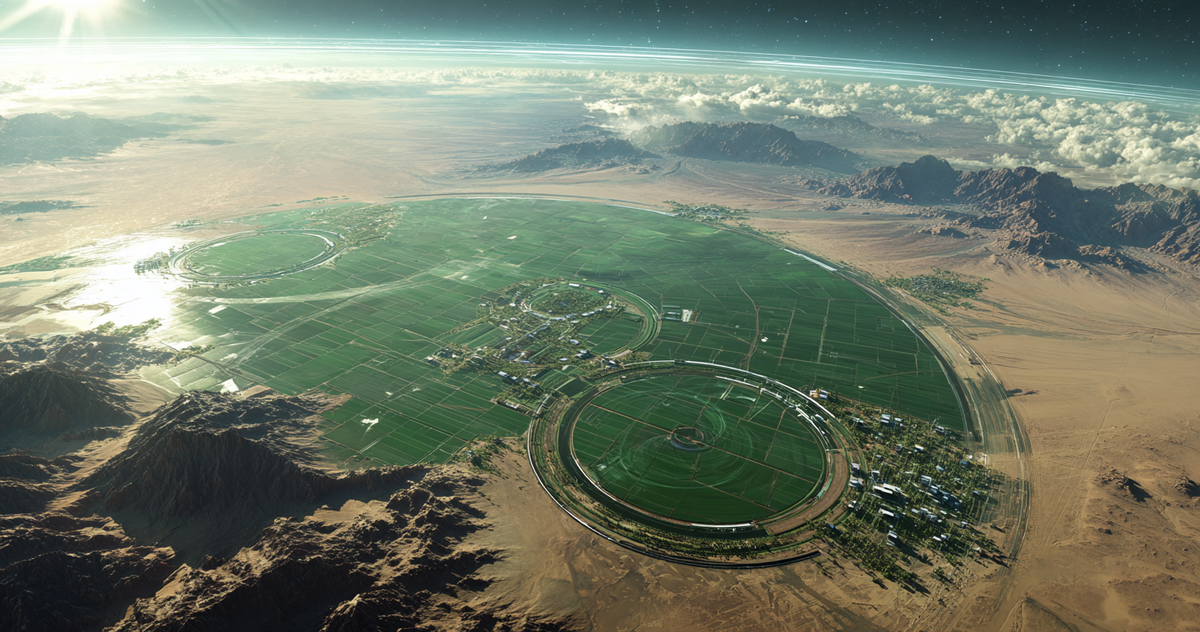
From massive center-pivot “crop circles” in the Sahara to biodynamic regeneration and waste-to-resource tech — how Egypt’s circular agriculture offers blueprints for sustainable Mars colonies.
Hey folks, it’s your Engineering Uncle here! When most people think of farming in Egypt, they picture the Nile Valley. But today, engineers are doing something remarkable in the harsh Sahara Desert — creating circular oases of productivity. This isn’t traditional peasantry farming; it’s advanced circular farming that recycles water, nutrients, and waste in closed loops. And the best part? These same principles are exactly what we’ll need to colonize Mars.
Egypt’s Desert “Crop Circles” — Center-Pivot Irrigation Mastery
If you look at satellite images of Sharq El Owainat or Toshka in Egypt’s Western Desert, you’ll see giant green circles — some up to a kilometer wide. These are created by center-pivot irrigation systems. A central well draws ancient groundwater from the Nubian Sandstone Aquifer, and long rotating arms spray water evenly across the circle.
This method is incredibly efficient:
- Uniform water distribution minimizes evaporation in 40°C+ desert heat.
- Precise control reduces waste compared to flood irrigation.
- Allows large-scale farming in areas that were once barren sand.
Egypt is investing billions (including massive projects with artificial rivers) to reclaim desert land and boost food security.
SEKEM and True Circular, Regenerative Farming
One standout example is SEKEM, founded in 1977 by Ibrahim Abouleish. They transformed barren desert into a thriving biodynamic farm using:
- Crop rotation and companion planting
- Composting and natural fertilizers
- Animal integration (cows, chickens) for natural manure and pest control
- Zero-waste philosophy — turning all byproducts back into the system
SEKEM proves that circular systems can regenerate soil, increase biodiversity, and create sustainable communities even in extreme environments.
Waste-to-Resource & Bioeconomy
Egypt produces millions of tons of agricultural waste annually. Modern circular projects turn this into:
- Biogas for energy
- Organic fertilizers
- Animal feed or mushroom substrates
- Compost to rebuild desert soil
Combined with drip irrigation, hydroponics, and precision sensors, these systems close the nutrient and water loops — wasting almost nothing.
Direct Lessons for Mars Colonization
Mars has no fertile soil, almost no liquid water, extreme cold, high radiation, and a thin CO₂ atmosphere. Every resource must be recycled in closed loops — just like Egypt’s best circular farms.
Key Transferable Technologies:
- Closed-loop water recycling — Egypt’s precision irrigation + wastewater treatment mirrors the water reclamation systems NASA is designing for Mars habitats.
- Regenerative soil building — SEKEM-style composting and microbial enhancement can turn Martian regolith into fertile soil.
- Center-pivot style systems adapted for greenhouses or domed habitats to maximize limited water and light.
- Waste-to-resource — Turning human and plant waste into fertilizer, fuel, and oxygen (exactly what BioHome or MELiSSA projects aim for).
- Data-driven precision — Sensors, drones, and AI already used in Egyptian smart farms will be essential for autonomous Mars agriculture.
Future Martian colonies could use hybrid systems: hydroponics/aeroponics for quick growth, regenerative soil beds for long-term sustainability, and circular waste processing to achieve near 100% resource recovery.
Egypt’s real-world success in turning desert into productive, sustainable farmland gives engineers confidence that we can do the same — and more — on Mars.
The shift from open-loop extraction to circular systems is the future of both Earth’s deserts and humanity’s expansion into space. That’s engineering at its most inspiring.
Stay curious, think in loops, and let’s keep building sustainable futures — whether in the Sahara or on the Red Planet!
FAQ (SEO/AEO Optimized)
What are Egypt’s circular “crop circles”?
Giant center-pivot irrigation systems in the Sahara that create perfectly round, highly efficient farms using groundwater.
How does SEKEM practice circular farming?
Through biodynamic methods, composting, crop rotation, and integrating animals — turning waste into resources while regenerating desert soil.
Why is circular farming important for Mars?
Mars has extremely limited resources — everything (water, air, nutrients, waste) must be recycled in closed loops for long-term survival.
How does precision agriculture help in desert and space farming?
Sensors, drones, and AI deliver exact amounts of water and nutrients, minimizing waste in harsh environments.
Can Egypt’s techniques be used on Mars?
Yes — water recycling, soil regeneration, and waste-to-resource systems from Egyptian projects are directly applicable to Martian habitats.
What makes circular systems more sustainable?
They reduce external inputs, minimize pollution, rebuild soil, and create resilient food production in challenging conditions.